

As more students pursue increasingly narrow and technical curricula, employers note that too many graduates lack crucial skills. In this context, a humanities background can provide a competitive advantage on the job market.
Humanities students participate in discussion-based courses, developing oral communication skills and giving them leg up over students who take mostly large lecture courses.
81%
of employers surveyed rated oral communication a “very important” skill.
Only 49%
of employers reported that recent graduates are “very prepared” in this area.
Students who take more humanities courses hone their writing skills.
77%
of employers surveyed rated written communication a “very important” skill.
Only 54%
of employers reported that recent graduates are “very prepared” in this area.
Humanities courses teach students to critically analyze an argument and consider alternatives.
78%
of employers surveyed said critical thinking is a “very important” skill.
Only 49%
of employers reported that recent graduates are “very prepared” in this area.
In humanities courses, students evaluate others’ arguments and integrate different types of evidence to make their own.
70%
of employers indicated that locating and evaluating information from a variety of sources is a “very important” skill.
Only 54%
of employers reported that recent graduates are “very prepared” in this area.
“Just think about the world today—about globalization, about the need to understand different cultures and perspectives, the ability to be intellectually curious … What we really need today are people who have broad perspectives… A liberal arts education is critical in providing people with broad perspectives and helping them to ultimately become effective leaders.”
Kenneth I. Chenault
Former Chairman and CEO of American Express
Evidence also shows that a humanities background is a competitive advantage for those who pursue graduate study.
Humanities students excel on grad entrance exams not only in humanities-related fields like law but also in medicine.

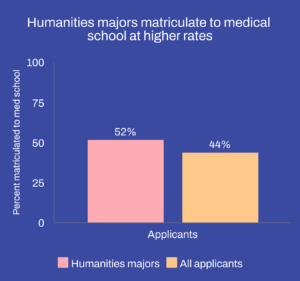
Historical data shows a similar pattern of elevated entrance exam scores and acceptance rates for humanities majors applying to business school and law school compared to their peers.
Pursue a liberal arts education. For most people, it’s the best foundation for a successful career… The formula for businesses trying to compete in today’s economy is simple: hire employees with the mental agility, leadership and passion to navigate constant change – in other words, hire those who are liberally educated.
A.G. Lafley
Former CEO of Procter & Gamble
Evidence shows that career success depends not on the specific content students study in college but rather the highly transferable skills highlighted above.
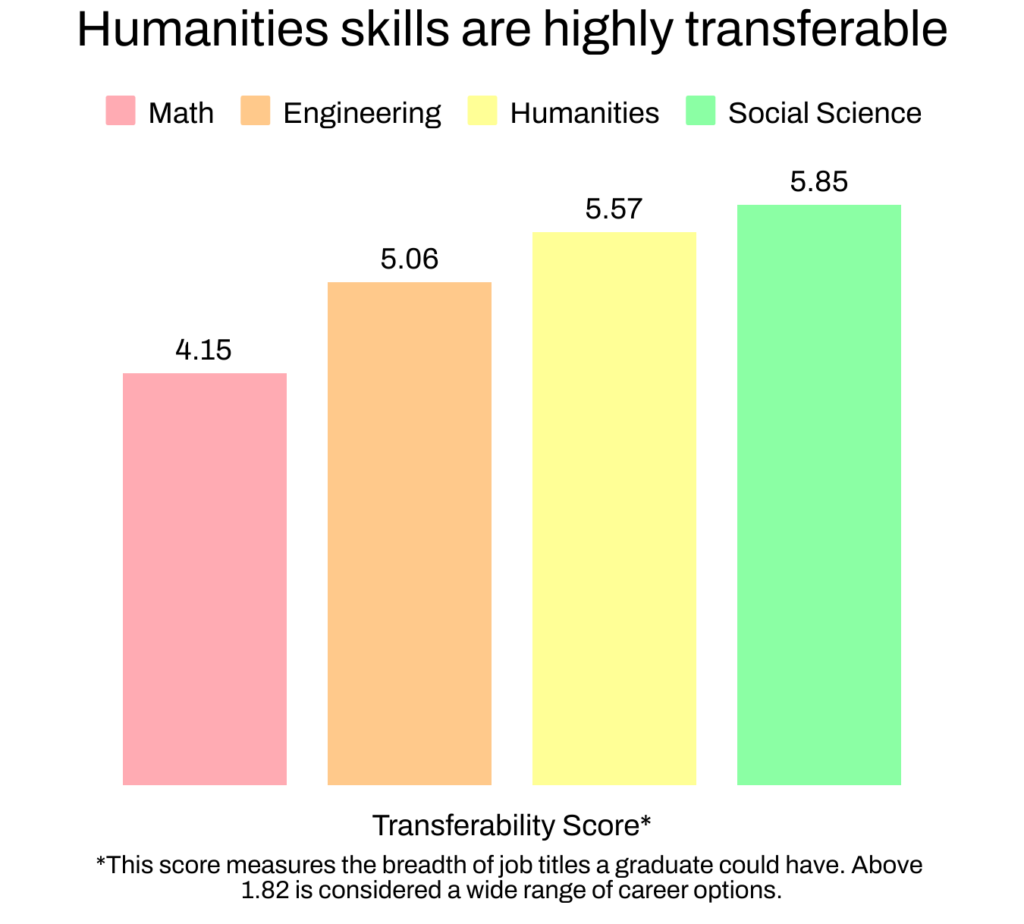
As a result, students who study the humanities thrive in a wide variety of industries.
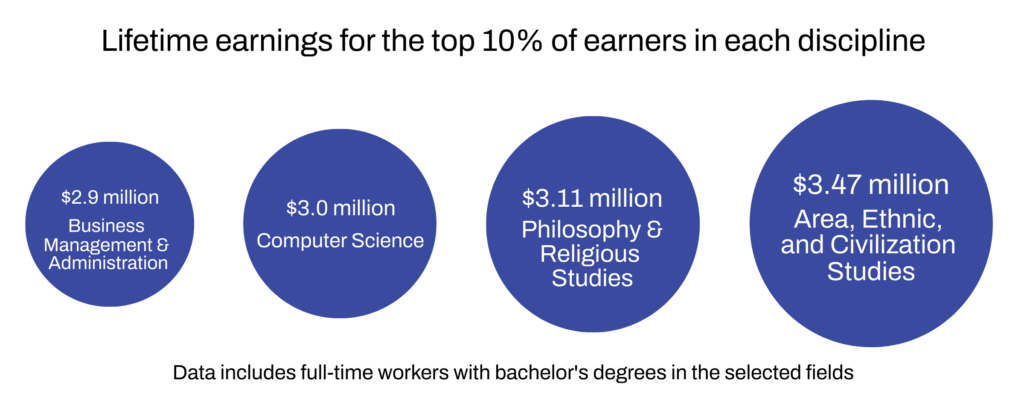
Humanities majors who prioritize high earnings are able to achieve their goals.
Over 25%
of those who earn humanities bachelor’s degrees but do not pursue graduate degrees end up earning over $100,000 a year.
In the long run, the “return on investment” from a humanities degree often exceeds that of degrees that are commonly assumed to be more lucrative.
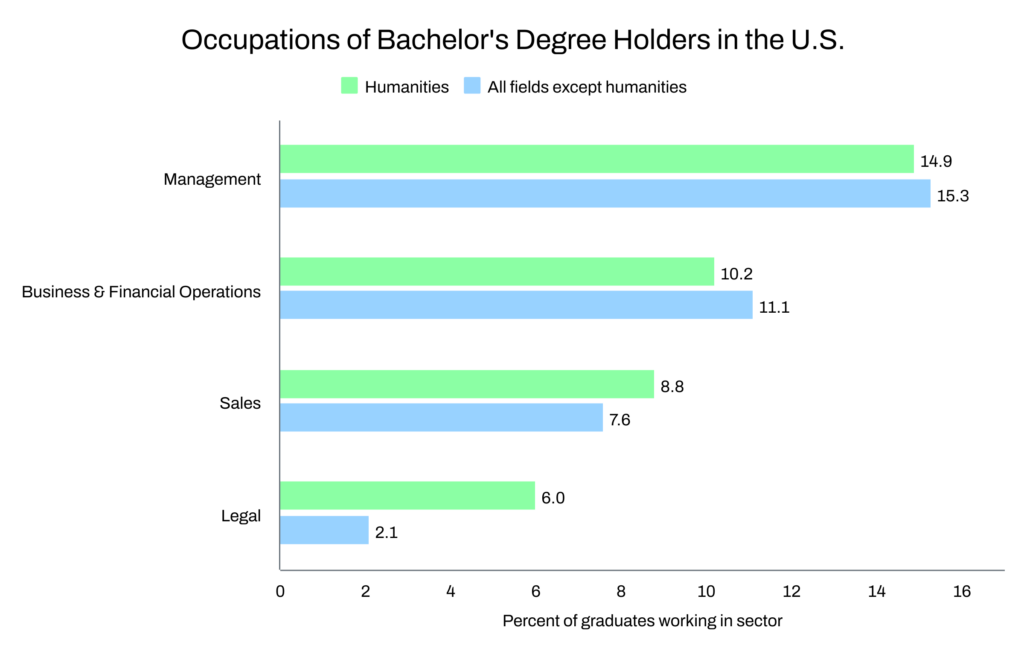
Humanities majors are roughly as likely as other graduates to work in high-earning fields like management, finance, and sales. And they are more likely than their peers to work in the legal profession.
But humanities majors also know money isn’t everything.
Many pursue careers that are fulfilling—and needed for society—even while they may not be as well-compensated as more market-driven careers.
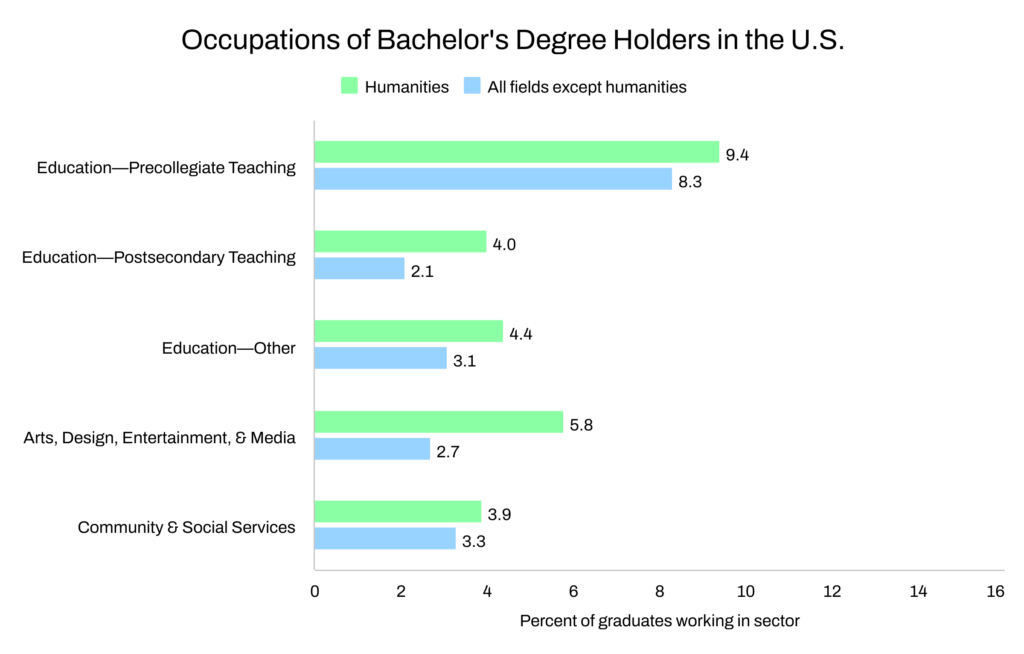
And even as humanities majors pursue mission-driven work in fields characterized by high job satisfaction, overall, their earnings keep pace with other majors over the course of their careers.
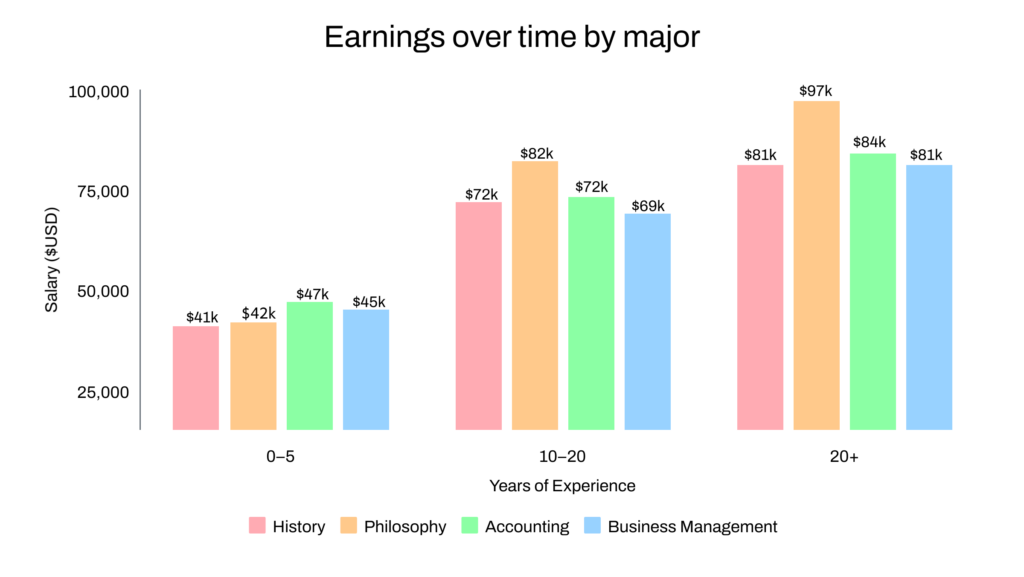
Many humanities majors find ways to build careers that are both mission-driven and highly compensated. As the stories in the second season of our podcast linked below illustrate, you can both do good and do well with a humanities degree.

“Increasingly, in a world where technology fills the roles once occupied by people, we’ll see the importance of agile problem-solving, communications, and critical thinking. That’s the work that only humans can do.”
Jamie Merisotis
President and CEO of Lumina Foundation
The humanities equip students with the capacities they need to adapt to change over their lifetimes.
The labor market of the future is predicted to be characterized by instability and rapid change. Unlike a narrow technical education, a humanities education will never become obsolete.
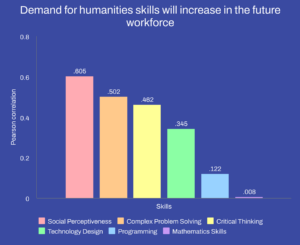

“If people want a skill set that can adapt and ride the wave of workplace automation, they should look to—the humanities. Having knowledge of human culture and history allows us to shape the direction of how technology is developed, identifying what problems it should solve and what real-world concerns should be considered throughout the process.”
Shon Burton
Founder and CEO of HiringSolved
Studying the humanities prepares students to navigate the challenges of tomorrow.
Tomorrow’s leaders will need to navigate cross-cultural communications, questions of diversity and inclusion, and increasingly complex ethical challenges.
In humanities classrooms, students wrestle with varying perspectives on these complex issues and acquire the tools necessary to rise to the challenges of 21st-century leadership.
Business leaders agree that future leaders must embrace ambiguity and complexity rather than search for simple solutions.
81%
of surveyed business leaders who believe that 21st century leaders face new and unique challenges think that the “ability to lead through more complexity and ambiguity” is the most important requirement for 21st century leaders.

“The ability to learn new things, collaborate, communicate and adapt to changing environments may become the most important skills for long-term employability.”
Microsoft, 2023



View citation information and links for the data and quotes included above.